Understanding Mid-Century Ranch Foundations in Clifton and Orchard Mesa
If you own a mid-century ranch home in Clifton or Orchard Mesa, you likely have one of two foundation types: a concrete slab or a crawl space. Understanding which you have is the first step toward choosing the right insulation strategy for your home. Most mid-century ranches built between the 1940s and 1970s in the Grand Junction area were constructed with either shallow crawl spaces or slab-on-grade foundations, depending on local soil conditions and building practices of that era.
Crawl spaces are particularly common in homes built on slightly elevated terrain, while slabs were preferred in flatter areas or where soil stability was a concern. The distinction matters enormously when you're evaluating insulation options. A crawl space exposes your home's underside to outside air, moisture, and temperature fluctuations, making it a critical zone for energy loss. Slab foundations, while more stable, can still lose significant heat through the perimeter edges and underlying soil. Knowing your foundation type helps you understand why certain insulation materials perform better than others in your specific home.
Spray Foam vs Blown-In Insulation: Why Spray Foam Wins for Crawl Spaces
When comparing spray foam vs blown in insulation, the differences become especially clear in crawl space applications. Blown-in insulation, whether fiberglass or cellulose, relies on gravity and dense packing to create an air barrier. In a crawl space, this approach has inherent limitations. Blown-in materials can settle over time, compress under their own weight, and struggle to seal irregular surfaces, rim joists, and rim band areas where air leakage is most problematic. Additionally, crawl spaces are prone to moisture intrusion from the ground, and blown-in insulation absorbs moisture readily, which degrades its R-value and can promote mold growth.
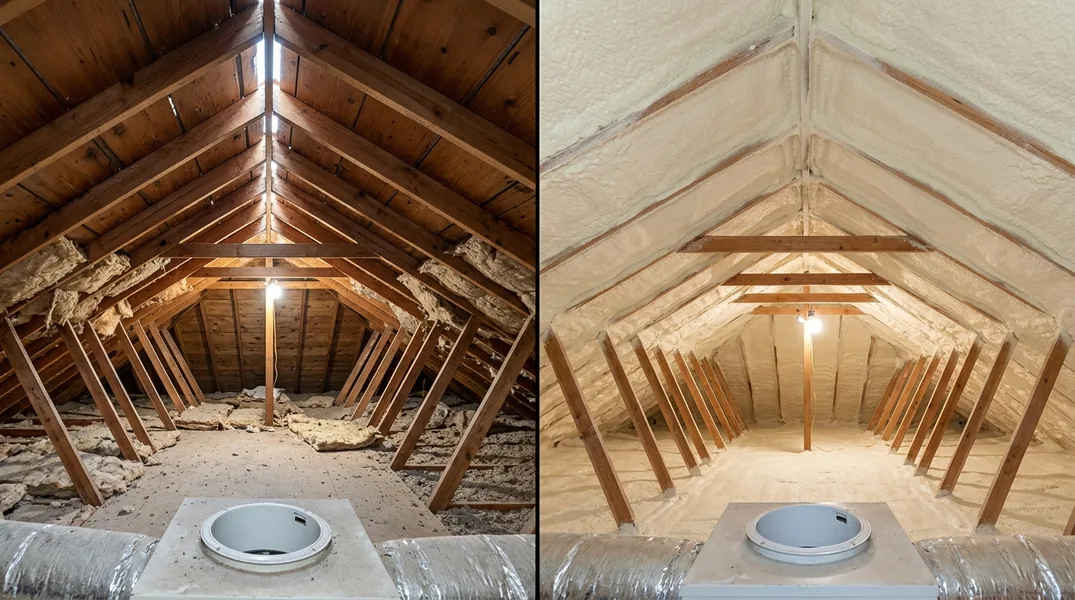
Attic Spray Foam Insulation and crawl space spray foam create a continuous, monolithic air and vapor barrier that adheres to all surfaces, including pipes, ducts, and irregular framing. This seamless seal prevents air infiltration far more effectively than loose-fill alternatives. Spray foam also resists moisture absorption, making it ideal for below-grade environments where humidity is a constant concern. When you're deciding between spray foam vs blown in insulation for a crawl space retrofit, the superior performance of spray foam becomes a clear investment in long-term comfort and energy savings.
Spray Foam vs Fiberglass: Moisture Control and Durability
Fiberglass batts and rolls have been the standard insulation choice for generations, but when you examine spray foam vs fiberglass in a crawl space or attic setting, several performance gaps emerge. Fiberglass is hydrophilic, meaning it absorbs and retains moisture. In a damp crawl space common to many mid-century homes in the region, fiberglass loses effectiveness and becomes a breeding ground for mold and mildew. The material also settles and compresses over decades, leaving gaps that allow warm air to escape in winter and cool air to leak out in summer.
Spray foam, by contrast, is hydrophobic and maintains its R-value even in humid conditions. Closed Cell Spray Foam Insulation is particularly moisture-resistant and provides structural reinforcement to framing, adding rigidity to older homes that may have developed settling or movement. Open cell spray foam offers excellent air sealing with slightly lower density and cost, though closed cell is generally preferred for crawl spaces and below-grade applications where moisture risk is highest. For homeowners in Clifton and Orchard Mesa dealing with legacy insulation that's degraded or failed, upgrading to spray foam is often the most durable long-term solution.
Best Insulation for Attic: Why Spray Foam Beats Cellulose and Blown-In Options
When it comes to the best insulation for attic spaces in mid-century ranches, the competition between spray foam and cellulose is worth examining closely. Cellulose is an eco-friendly option made from recycled paper, and it has a higher R-value per inch than fiberglass. However, cellulose also absorbs moisture and can settle significantly over time, sometimes losing 20 percent or more of its depth within the first few years. It also requires careful installation to avoid voids, and it's more prone to pest damage than spray foam.
Spray foam creates an uninterrupted thermal envelope in your attic, sealing air leaks around rafters, penetrations, and the attic perimeter that blown-in materials miss. This comprehensive air sealing reduces the load on your HVAC system and maintains more consistent indoor temperatures. For the best insulation for attic performance, spray foam delivers superior air sealing, moisture resistance, and longevity. Many homeowners in Grand Junction who've upgraded from cellulose or blown-in insulation to spray foam report noticeable improvements in comfort and heating and cooling efficiency within the first heating season.
Attic Spray Foam Insulation Near Me: When to Call a Professional
If you're a homeowner in Clifton or Orchard Mesa with a mid-century ranch, deciding whether to upgrade your insulation is often driven by energy bills, comfort issues, or visible signs of aging insulation. Many DIY insulation projects are tempting, but spray foam application requires specialized equipment, training, and safety precautions. Improper mixing ratios, inadequate ventilation, and incorrect application technique can result in poor performance, off-gassing, or even structural issues. Professional installation ensures that your spray foam is applied at the correct density, coverage, and thickness to meet building codes and manufacturer specifications.
When you're ready to explore spray foam options for your crawl space or attic, reaching out to a qualified local contractor is the smart first step. Grand Junction Spray Foam Insulation serves the entire region and can assess your home's specific foundation type, existing insulation condition, and energy loss patterns. A professional evaluation often reveals opportunities you might miss on your own, such as rim joist gaps, ductwork leaks, or moisture issues that need addressing before insulation is installed. Contact us at (970) 200-8449 or request a free estimate to learn how spray foam can transform your home's comfort and efficiency.
Attic Spray Foam Insulation Cost in Grand Junction: What to Budget
Understanding the cost of upgrading to spray foam insulation is essential for homeowners planning a retrofit. Spray foam is more expensive upfront than blown-in insulation or fiberglass batts, typically ranging from $1.50 to $3.50 per board foot depending on whether you choose open cell or closed cell, the complexity of your space, and regional labor rates. For a typical 1,200 square foot attic, homeowners can expect to invest between $3,000 and $7,000 for professional spray foam installation. Crawl space projects vary widely based on size and accessibility, but budget $2,000 to $5,000 for a standard crawl space retrofit.
While the upfront cost is higher than alternatives, the long-term return on investment is compelling. Spray foam reduces energy consumption by 15 to 30 percent in many homes, translating to lower utility bills month after month for years. Many homeowners recoup their investment within 5 to 10 years through energy savings alone. Additionally, improved comfort, better moisture control, and the durability of spray foam mean fewer future repairs and replacements. For detailed pricing tailored to your specific project, contact Grand Junction Spray Foam Insulation at (970) 200-8449 or submit your information online for a customized quote.
Looking for a professional spray foam insulation contractor in Grand Junction? Grand Junction Spray Foam Insulation responds fast for all your spray foam insulation needs.
Get a Free Quote