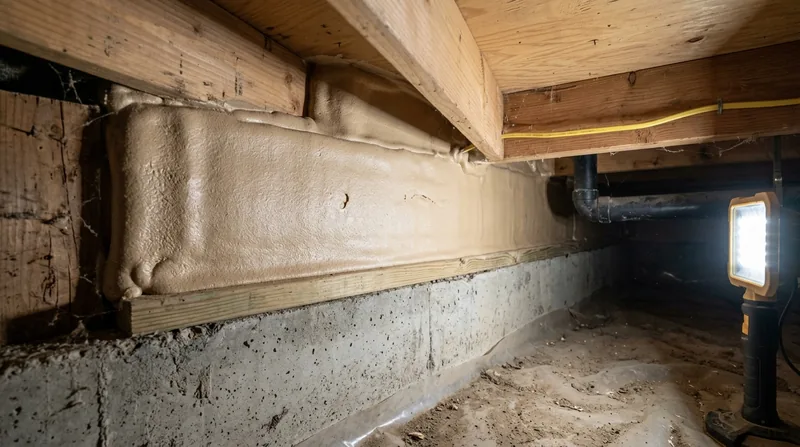




Closed cell spray foam insulation in Grand Junction delivers both air sealing and structural strength where it matters most: rim joists, walls, crawl spaces, and metal buildings across the high desert. Grand Junction sits in IECC climate zone 5B, where hot dry summers push cooling loads hard and clear winter nights drop temperatures fast, creating a double energy burden that air leakage amplifies. The stack effect in older homes near downtown and along North Avenue, combined with thin or settled insulation in mid-century ranches across Clifton and Orchard Mesa, means the real enemy is air infiltration, not moisture. Closed cell foam stops that leakage cold, adds measurable R-value per inch, and resists vapor transmission where it counts. Unlike open cell foam or blown-in fiberglass, closed cell creates a true air barrier and handles the temperature swings that define Mesa, Delta, Garfield and Montrose county homes. We remove old insulation, seal air leaks at the source, and install closed cell foam to spec with written estimates showing R-value and thickness before we spray.
Why Closed Cell Spray Foam Insulation Matters in Grand Junction's High Desert Climate
Grand Junction's temperature swings are brutal on insulation. July afternoons hit the mid-90s and cool to the 50s at night; winter valley inversions trap cold air and hold it for days. A vented attic or a rim joist with air gaps becomes a highway for heat loss and cooling gain. Closed cell foam stops that air movement, holds an R-value of 6.0 to 7.0 per inch, and does not settle or compress over time the way open cell or fiberglass does. The low humidity in the Grand Valley means moisture is rarely your problem; air leakage is. Closed cell foam addresses that directly.
- Closed cell foam delivers an air barrier and structural reinforcement in a single application, critical for rim joists and band joists on older Grand Junction crawl spaces.
- High R-value per inch (6.0 to 7.0) matters in tight spaces where depth is limited, such as walls in pre-1980 stock or shallow rim cavities in Redlands and Fruita subdivisions.
- Closed cell resists vapor transmission and handles Grand Junction's daily temperature extremes without degradation or air-gap formation over decades.
- It works on metal buildings and barndominiums scattered across the valley, where condensation control on steel framing is the defining use case for the product.
When you pair closed cell foam with air sealing at top plates, recessed lights, and band joists, you cut the stack effect that drives your heating and cooling bills through the roof.
Key info: A rim joist in a Clifton or Orchard Mesa crawl space sealed with closed cell foam stops cold air infiltration at the foundation line, where the stack effect is strongest. This is the single highest-impact retrofit on older homes in the area.
For more on how closed cell fits into your overall insulation strategy, see our guide to air sealing in Grand Junction.
How We Install Closed Cell Spray Foam Insulation in Grand Junction: The Process
We start with a walk-through to identify where closed cell makes sense: rim joists, walls, crawl spaces, garage rim and band, or sealed attic roof decks. We measure thickness and coverage, pull any old insulation that blocks access or is compromised, and seal air gaps at the substrate. Before we spray, we verify the substrate is dry and stable; we will not apply foam over wet, contaminated, or actively leaking areas. Once we confirm conditions, we set up mechanical ventilation to manage cure vapors, spray the foam in controlled passes to the specified thickness, and establish a re-entry window of twenty-four to forty-eight hours. We provide a written estimate with R-value and thickness before we start.
- We inspect the substrate and identify air leaks, settling insulation, and moisture or contamination that must be addressed before foam is applied.
- We remove old insulation, debris, and obstructions so the substrate is clean and the foam can adhere properly to the full cavity.
- We seal gaps, cracks, and penetrations with caulk or foam backer rod to create a continuous air barrier.
- We set up mechanical ventilation and spray closed cell foam in multiple passes, maintaining manufacturer ratio and drum temperature throughout.
- We document thickness, coverage, and R-value achieved, and provide a re-entry timeline based on ambient temperature and humidity.
The result is an air-tight, high-R thermal barrier that handles Grand Junction's temperature extremes and lasts for decades without settling or degrading.
Example: A 1960s ranch in Orchard Mesa with a shallow crawl space and a thin layer of settled fiberglass over the rim joist. We remove the old insulation, seal the rim cavity, and spray closed cell foam to 3 inches, achieving R-21 and a complete air seal. The homeowner notices warmer floors in winter and less cooling load in summer within days.
To understand how this complements other air-sealing work, review our rim joist and band joist spray foam service.
Closed Cell Spray Foam Applications and Methods
| Application | Closed Cell Method | Why It Works in Grand Junction |
|---|---|---|
| Rim and band joists | Spray to 2 to 4 inches in cavities, creating an air barrier at the foundation line. | Stops the stack effect at the point where it is strongest; eliminates cold floors and drafts in Clifton and Orchard Mesa crawl spaces. |
| Wall cavities (retrofit) | Injection foam or low-pressure spray into walls without demolition; typically 1.5 to 2 inches. | Retrofits pre-1980 stock in downtown Grand Junction and Fruita without tearing open walls; fills settled or thin cavities in one pass. |
| Crawl space walls and headers | Spray to 2 to 3 inches on rim and band, and optionally on walls for full encapsulation support. | Seals the thermal envelope at the perimeter; reduces heating and cooling load and improves floor comfort year-round. |
| Metal buildings and barndominiums | Spray 2 to 4 inches on the underside of roof deck or walls; closed cell resists condensation on steel. | Metal buildings across the valley and into the Book Cliffs face wide temperature swings; closed cell stops condensation and provides both R-value and a vapor barrier. |
| Sealed attic roof decks | Spray 4 to 6 inches on the roof deck or rafter underside, creating a conditioned attic. | Newer subdivisions in Redlands and Fruita with trussed attics benefit from a sealed, conditioned attic that cuts cooling load in summer and heat loss in winter. |
Closed Cell Spray Foam Insulation Cost in Grand Junction: What to Expect
Closed cell spray foam in Grand Junction typically costs between $1.20 and $2.00 per board foot, depending on access, substrate condition, and the scope of air sealing required. A rim joist retrofit on a 1,200-square-foot home might run $1,500 to $2,500; a crawl space perimeter seal could be $2,000 to $4,000; a wall cavity retrofit depends on the wall area and whether injection or low-pressure spray is used. The main cost drivers are the size of the area to be sprayed, how much old insulation must be removed first, whether the substrate is clean and dry (if not, we prep it at additional cost), and travel distance within our service area. We do not charge a separate travel fee within Grand Junction, Clifton, Redlands, Orchard Mesa, Fruita, Palisade, Delta, and surrounding areas.
Every estimate includes written R-value and thickness specs so you know exactly what you are paying for. We recommend getting two or three estimates from different contractors so you can compare approach, insurance, and warranty terms. The cheapest estimate is often the one to avoid; it usually means no written spec, no mechanical ventilation during cure, or a promise to re-enter immediately after spraying, all of which are red flags. For detailed pricing on your specific project, see our pricing overview or call us at (970) 200-8449 for a free, no-obligation estimate.
Closed Cell Spray Foam Insulation Near Me: What Grand Junction Homeowners Should Know When Hiring a Contractor
Finding the right spray foam contractor is critical because the installation technique and the materials matter as much as the product itself. Before you hire anyone, verify that they carry full insurance (general liability and workers compensation); ask to see the certificate. Do not accept a contractor who claims to be licensed for spray foam work in Colorado without proof, and do not let them tell you that licensing does not apply here; instead, verify any licensing claim directly with the Colorado Secretary of State or your city building department. Get at least two written estimates that specify R-value and thickness, and compare them side by side. Ask whether they use mechanical ventilation during cure and what re-entry window they recommend; if they promise immediate re-entry, walk away. Check references, especially recent jobs in your neighborhood, and ask past clients about curing odors and whether the contractor was reachable if questions came up after the work.
- Verify full insurance coverage and ask for a certificate of insurance naming you as additional insured before any crew arrives on site.
- Request written estimates with R-value and thickness specified, and compare at least two contractors to understand the range in approach and cost.
- Ask how the contractor handles substrate prep, old insulation removal, and moisture or contamination; if they gloss over it, that is a bad sign.
- Confirm that mechanical ventilation is set up during cure and ask for the re-entry window based on temperature and humidity at the time of spray.
- Check references from recent jobs in Grand Junction, Clifton, or Orchard Mesa, and ask about curing odors, timeline, and whether the contractor was available for follow-up questions.
If your home is in an HOA community or a historic district, check your architectural guidelines before you start; most do not restrict insulation work, but some do govern exterior wall repairs or metal building finishes. Your city building department can tell you whether a permit is required for your address and what inspections apply. For more guidance and to schedule a free estimate, contact us today.
Closed Cell Spray Foam Insulation in Grand Junction: Pricing Guide
| Service | Price | Details |
|---|---|---|
| Rim joist and band joist sealing | Starting at $1.20/board ft | 2 to 4 inches of closed cell foam in rim cavities; cost depends on linear footage and substrate access |
| Crawl space perimeter and walls | Starting at $1.50/board ft | Rim, band, and optional wall coverage; larger crawl spaces and difficult access increase cost per board foot |
| Wall cavity retrofit (injection or low-pressure spray) | Starting at $1.40/board ft | Pre-1980 stock retrofits without demolition; cost varies by wall area, cavity condition, and whether old insulation is removed first |
| Metal building or sealed attic roof deck | Starting at $1.60/board ft | Roof deck or rafter underside; cost depends on building footprint, height, and roof geometry; metal buildings in remote locations may carry travel time |
| Insulation removal and disposal | Included in estimate | Old fiberglass, cellulose, or failed foam is removed before new foam is applied; disposal cost rolls into the overall project price |
| Free estimate | No charge | Written R-value and thickness spec provided; response within 24 hours at (970) 200-8449; no obligation to book |
Indicative pricing, the exact cost depends on square footage, finish, and site access. Free personalized estimate within 24h at (970) 200-8449.


