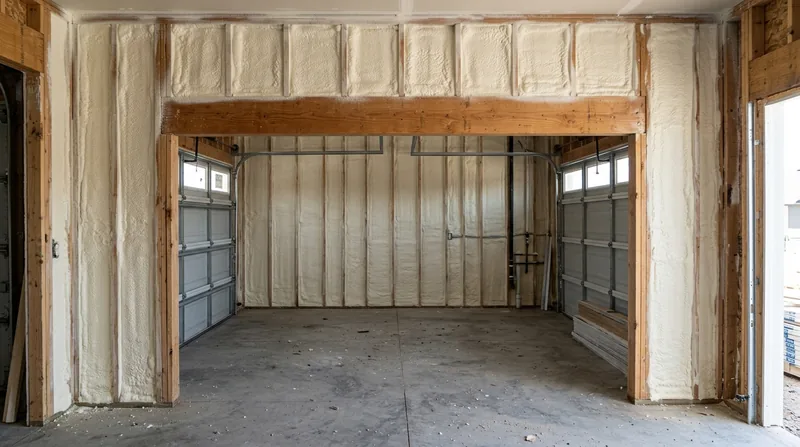




Grand Junction garages face a unique thermal challenge: hot, dry summer days that push interior temps into the 90s, followed by cold winter nights where heat escapes through every gap and crack. Whether your garage is attached to your home or a standalone shop, uninsulated or poorly insulated walls and ceilings let the outside air dictate your comfort and energy use. Garage spray foam insulation in Grand Junction seals air leaks and stabilizes interior temperatures year-round, protecting tools, vehicles, and living spaces from the wide temperature swings that define the high desert. We spray foam garage walls, ceilings, and rim joists across Mesa County to create a continuous air barrier that works against both summer heat gain and winter heat loss. This is not a luxury upgrade; it is a direct response to the climate and building science of the Grand Valley.
Why Garage Spray Foam Insulation Matters in Grand Junction's High Desert Climate
Grand Junction sits in IECC climate zone 5B with temperature swings that stress a home or shop in opposite directions within the same day. An uninsulated garage ceiling allows hot summer air to pour through the attic and into the living space above, forcing your air conditioning to work overtime. In winter, the same uninsulated ceiling becomes a thermal sieve: cold air settles, heat escapes upward, and the stack effect pulls warm interior air out through every penetration and gap. The problem is not humidity, which stays low year-round, but air leakage. Spray foam creates a continuous seal that stops the exchange of interior and exterior air, stabilizing the temperature on both sides of the wall or ceiling.
- Spray foam adheres to framing and blocks air movement through studs, rim joists, and ceiling cavities in ways fiberglass batts cannot.
- Closed cell foam adds structural rigidity to garage walls and resists moisture in the unlikely event of a water intrusion.
- Open cell foam provides excellent sound dampening and is less dense, making it suitable for garages where thermal resistance is the priority and cost matters.
- The air seal itself, not the R-value alone, is what stops the stack effect that dominates heating and cooling load in the Grand Valley.
A spray foam garage transforms a space that tracks the outdoor temperature into one that holds a stable interior climate, protecting your vehicles and tools while reducing the load on your home's HVAC system.
Key info: The Colorado Building Code and local Grand Junction building officials govern attic ventilation, ignition barriers, and thermal barriers on spray foam. A fifteen-minute thermal barrier (typically drywall or intumescent paint) is required in many residential applications. Always check with your local building department before starting work, and we help navigate what applies at your address.
For more detail on how spray foam insulation works across different applications, see our closed cell spray foam page and open cell spray foam page.
How We Spray Foam Your Garage in Grand Junction: The Process
A garage spray foam project begins with a site visit and a written estimate that specifies the R-value, foam thickness in inches, and the total board feet we will apply. We assess the existing insulation, identify air leaks around doors, windows, rim joists, and the ceiling line, and determine whether the substrate is clean and dry. If old insulation is in the way or the framing is wet, we remove or dry it first. Once the space is ready, we set up mechanical ventilation to manage VOC emissions during the spray, mask off areas that should not be foamed, and spray in controlled passes to build thickness without overflow or uneven coverage. After cure (typically 24 to 48 hours), we verify coverage and thickness, and the space is ready for use.
- We conduct a thorough on-site inspection and provide a written estimate with R-value and thickness specifications before any work begins.
- We remove or replace insulation that is damaged, settled, or wet, never spray over a compromised substrate.
- We install mechanical ventilation during the spray and cure process to manage off-gassing and ensure proper chemical reaction.
- We specify a re-entry window of 24 to 48 hours and provide guidance on safe occupancy after cure.
- We inspect the finished job for even coverage, proper thickness, and compliance with local building code thermal barrier requirements.
The result is a garage that holds a stable interior temperature and stops air leakage at its source, not just the surface.
Example: A mid-century ranch in Orchard Mesa with an attached two-car garage and a vented attic above it had summer cooling bills that spiked when the garage door was opened on hot days. The garage had no ceiling insulation and the rim joist where the garage roof met the house frame was open to the attic. We sprayed 5.5 inches of closed cell foam on the garage ceiling and sealed the rim joist, creating a thermal break that stopped hot air from flowing into the living space. The homeowner reported a noticeable drop in cooling load within the first week.
For a detailed look at our air sealing approach, visit our air sealing page.
Spray Foam Methods for Garage Insulation
| Approach | Description | Best for |
|---|---|---|
| Closed Cell Spray Foam | High-density foam with a closed cellular structure, typically 5.5 to 6 inches thick for an R-value of 38 to 42. Provides air seal, moisture resistance, and structural support. | Attached garages, metal building walls, and rim joists where thermal performance and structural benefit justify the higher cost. |
| Open Cell Spray Foam | Lower-density foam with open cells, typically 7 to 8 inches thick for an R-value of 24 to 28. Excellent air seal and sound dampening, lower cost than closed cell. | Standalone garages, workshops, and spaces where cost and sound control matter more than the structural benefit of closed cell. |
| Rim Joist and Band Joist Sealing | Targeted spray foam application to the perimeter where the garage meets the house frame, typically 1 to 3 inches of closed cell foam to seal air leaks and block thermal bridging. | Attached garages where the rim joist is the primary air leak path and the focus is stopping heat loss or gain at the thermal boundary. |
| Partial Retrofit with Existing Insulation | Spray foam applied to gaps, voids, and air leak paths in a garage with existing fiberglass or mineral wool insulation. Targets the air seal without full replacement. | Garages where the existing insulation is sound but has settled or where framing cavities are not fully filled. |
Garage Spray Foam Insulation Cost in Grand Junction: What to Expect
Garage spray foam insulation in Grand Junction starts at around $1,200 for a small, single-car garage with a straightforward ceiling and minimal wall work. The cost rises with the size of the space, the square footage of ceiling and walls to be foamed, the type of foam (closed cell costs more than open cell), and the complexity of the job. A two-car attached garage with ceiling and partial wall insulation typically runs $2,500 to $4,500, depending on foam type and existing conditions. If old insulation must be removed, the cost increases. Access, framing complexity, and the need to address moisture or damaged substrate also affect the final price. We provide a written estimate on site with R-value and thickness specifications so you know exactly what you are paying for before work begins.
The best way to understand the cost is to get two or three estimates from contractors in Grand Junction. Each estimate should include the board feet of foam, the thickness in inches, the R-value, and the labor. Avoid any estimate that lacks these details or quotes a price far below market with no inspection. For a detailed pricing breakdown, visit our pricing page.
What to Look for When Hiring a Spray Foam Insulation Contractor Near Grand Junction
Hiring the right spray foam contractor is as important as choosing the right product. A quality contractor will provide a written estimate with R-value and thickness, explain the difference between closed cell and open cell foam, and walk you through the cure time and re-entry window. They will also be fully insured and able to verify coverage on request. The spray foam trade has both national franchises and local independents, and also has a reputation for rig-and-run crews that spray a job in an afternoon and disappear when the smell lingers. The difference is accountability: a local contractor with a local address and a history in Grand Junction is reachable when questions arise.
- Ask for a written estimate that specifies R-value, foam thickness in inches, and total board feet, never a price per square foot without a detailed breakdown.
- Request references from recent garage or attic projects in Grand Junction and Clifton, and call them to ask about the quality of the work and the contractor's response after the job.
- Confirm that the contractor is fully insured and ask to see proof of coverage, which protects you if something goes wrong during the spray or cure.
- Ask about the mechanical ventilation plan during the spray and cure, and what re-entry window they recommend before the space is fully occupied.
- Understand that permits and thermal barrier requirements vary by city within Greater Grand Junction, and the contractor should help you navigate what applies at your address, never claim they pull all permits.
A contractor who answers your questions clearly, provides a detailed estimate, and explains the process is the one most likely to deliver a quality job. Contact us for a free, no-obligation estimate and a conversation about what works best for your garage.
Garage Spray Foam Insulation in Grand Junction: Pricing Guide
| Service | Price | Details |
|---|---|---|
| Single-car garage ceiling, open cell foam | Starting at $1,200 | Includes 6 to 8 inches of open cell foam on the ceiling with air seal at the rim joist, typical R-value 24 to 28 |
| Two-car attached garage, ceiling and walls, closed cell foam | Starting at $2,800 | Includes 5.5 inches of closed cell foam on ceiling and partial wall insulation, R-value 38 to 42, rim joist sealed |
| Rim joist and band joist sealing only | Starting at $600 | Targeted closed cell foam application to the perimeter where garage meets house frame, 1 to 3 inches thick, air seal focus |
| Insulation removal and replacement | On estimate | Removal of old fiberglass, mineral wool, or damaged foam, haul-away, and new spray foam installation require on-site inspection |
| Travel | Included | No separate charge for service calls to Grand Junction, Clifton, Orchard Mesa, Fruita, Palisade, and surrounding areas |
| Free written estimate | No obligation | Includes on-site inspection, R-value and thickness specs, and response within 24 hours at (970) 200-8449 |
Indicative pricing, the exact cost depends on square footage, finish, and site access. Free personalized estimate within 24h at (970) 200-8449.


