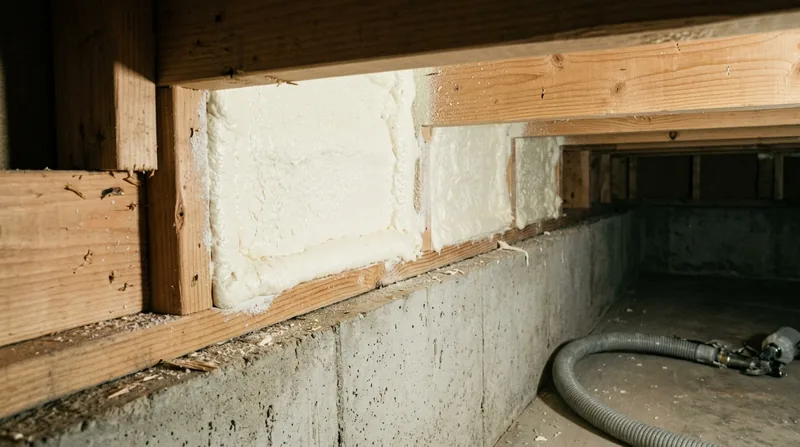




Rim joist and band joist spray foam is one of the highest-impact air sealing jobs in Grand Junction homes, especially through the cold winter nights that follow the valley's hot dry summers. The rim joist is the narrow band of framing where your floor system sits on top of the foundation wall, and it is one of the first places cold air enters during the stack effect that pulls heat out of your home when outdoor temperatures drop below freezing. In Grand Junction's high desert climate, where day-to-night temperature swings can exceed 30 degrees, this small but critical gap accounts for measurable heat loss and drafts that homeowners feel in rooms above crawl spaces and basement edges. We spray foam this perimeter to create an unbroken air barrier, stopping the infiltration that costs you money every heating season from September through April.
Why Rim Joist and Band Joist Leakage Matters in Grand Junction Homes
The rim joist is where the floor frame meets the foundation, and it is almost never insulated properly in older Grand Junction stock. Homes built in the 1950s and 1960s across Clifton, Orchard Mesa, and the North Avenue area were framed with minimal air sealing, leaving this band completely open to the crawl space or basement below. When cold air from an unheated crawl space rises into the rim cavity, it pulls warmth out of the walls and floors above, and that loss compounds across the entire perimeter of your home. Modern code now requires this area to be sealed, but retrofit homes need the work done deliberately and well.
- A typical Grand Junction home loses 15 to 25 percent of its heating energy through foundation air leaks, rim joists, and band joists combined.
- Drafts from the rim joist feel worst in rooms with floors over crawl spaces, especially on clear winter nights when the stack effect runs hardest.
- Sealing this band with spray foam stops cold air infiltration without requiring any interior demolition or disturbance to living space.
- Closed cell spray foam holds its R-value and air barrier properties even in unheated crawl spaces where humidity and temperature swings are extreme.
The result is warmer floors, fewer drafts, and a measurable drop in heating bills through the long winter season that defines energy demand in the Grand Valley.
Key info: Grand Junction sits in IECC climate zone 5B, where winter heating loads are driven by clear nights and valley inversions that hold cold air in place for days. A sealed rim joist is not optional in this climate; it is the difference between a tight, efficient home and one that bleeds heat every night from October through March.
How We Seal Rim Joists and Band Joists in Grand Junction Homes
Rim joist sealing starts with access to the foundation perimeter, which means crawling into the rim cavity or basement band and spraying closed cell foam directly onto the rim board, band board, and the rim cavity above. We work systematically around the perimeter, building up the foam in controlled passes to achieve the specified thickness and R-value, typically R-15 to R-21 depending on cavity depth and code requirements at your address. The foam expands slightly and fills the entire cavity, creating a continuous air barrier that stops infiltration at the source. After cure, the foam is hard, dimensionally stable, and ready for any future work in the crawl space.
- We access the rim cavity from the crawl space or basement and inspect the rim board, band joist, and rim cavity for moisture, damage, or debris that must be cleared before spraying.
- We set up mechanical ventilation to manage fumes and ensure safe working conditions during the spray and cure period, typically 24 to 48 hours before re-entry.
- We spray closed cell foam in multiple thin passes, controlling thickness per pass to ensure proper expansion, density, and adhesion to the substrate.
- We verify R-value and thickness with written specs on the estimate so you know exactly what you are getting and can confirm it on site.
- We allow full cure time before closing the crawl space or basement, and we provide clear guidance on re-entry windows and any precautions needed during the first few days.
This process is straightforward but exacting. The difference between a professional job and a poor one is whether the installer controls thickness, maintains proper drum temperature and ratio, runs mechanical ventilation, and respects the cure window. We do all four, every time. See our full air sealing service page for more detail on how we seal the complete thermal envelope.
Example: A 1,200 square-foot ranch home in Fruita with a crawl space and a 180-linear-foot rim joist perimeter typically takes 4 to 6 hours to spray and seal completely. The foam is applied in two or three passes over that time, and the home is ready for normal use within 48 hours of completion.
Rim Joist Spray Foam Methods: Closed Cell vs. Open Cell
| Approach | Description | Best for Rim Joists |
|---|---|---|
| Closed Cell Spray Foam | High-density, closed-cell structure with R-6 to R-7 per inch. Provides air barrier and moisture resistance. Requires proper ventilation during cure. | Standard choice for rim joists in crawl spaces and unheated basements where moisture risk is moderate and air barrier strength is critical. |
| Open Cell Spray Foam | Lower-density foam with R-3.5 to R-4 per inch. Softer, more flexible, and easier to trim. Vapor-permeable, allowing drying into living space. | Rarely used for rim joists because crawl spaces need moisture control and closed cell provides superior air sealing in that environment. |
| Injection Foam into Existing Cavities | Closed cell foam injected into hollow rim cavities without removal of existing material. Requires cavity inspection and drilling access points. | Homes where rim cavity is already framed and sealed on both sides but insulation has settled or is missing. Faster than full removal and re-spray. |
| Removal and Full Re-Spray | Complete removal of old, failed, or settled insulation followed by full closed cell spray foam application to specified R-value and thickness. | Rim joists with deteriorated fiberglass, old blown-in cellulose, or previous foam that has lost bond or developed gaps. Guarantees complete coverage and known R-value. |
For rim joists in Grand Junction, closed cell is the standard because your crawl spaces run cold and dry, the stack effect is severe in winter, and air sealing is more important than vapor permeability. We evaluate each rim joist on site and recommend the method that fits the cavity condition and your code requirements.
Rim Joist and Band Joist Spray Foam Cost in Grand Junction: What to Expect
Rim joist and band joist sealing in Grand Junction typically starts at around $650 for a small crawl space or partial perimeter, and scales upward based on the total linear footage of rim to be sealed, the depth and condition of the rim cavity, and whether existing insulation must be removed first. A typical 180 to 220 linear-foot perimeter on a mid-sized ranch or split-level home ranges from $1,200 to $2,400, depending on cavity size and access. Larger homes or those with complex foundation geometry cost more. The real cost driver is not the square footage of your home but the linear feet of rim joist that needs sealing and the condition of the cavity when we arrive.
Getting a written estimate with R-value and thickness specifications is essential. Any contractor who quotes a price per square foot or refuses to specify thickness and R-value is cutting corners or hiding poor work. We provide estimates with full specs at no charge within 24 hours. See our pricing page for detailed cost ranges and factors that affect your quote.
Why does cost vary so much between estimates? The honest answer is that rim cavities are not uniform. Some are 3 inches deep, others are 5 or 6 inches. Some have old fiberglass that must be removed; others are empty. Some are accessible from a crawl space; others require working from a basement rim or even partial excavation. Getting 2 or 3 estimates from different contractors is the only way to understand what your job actually requires and what the market rate is in your area. Unusually low estimates often reflect corners cut on ventilation, cure time, or thickness verification.
Rim Joist and Band Joist Spray Foam Near Me: What Grand Junction Homeowners Should Know When Hiring
Hiring a spray foam contractor for rim joist work requires the same diligence you would apply to any major home improvement. Start by verifying that any contractor you call is fully insured and can provide a current certificate of insurance on request. Ask for references from recent rim joist jobs in Grand Junction, Fruita, Palisade, or Clifton, and follow up with at least two of them. Verify that the contractor can explain the difference between closed cell and open cell foam, and why closed cell is the standard for rim joists. Any contractor who cannot articulate this difference is not experienced enough for this work.
Get at least two written estimates that include R-value, thickness, linear footage, and total cost. Do not accept a price without these specs. Ask whether the estimate includes removal of existing insulation if needed. Confirm that the contractor will run mechanical ventilation during the spray and cure, and that they will provide a clear re-entry window before you use the crawl space or basement again. Permitting varies by city across Greater Grand Junction, so ask your contractor what permits apply at your address and whether they help you navigate the local requirements. Contact the Grand Junction building department or your city clerk if you are unsure. For questions about how to verify any spray foam contractor, including us, call us at (970) 200-8449 or request a free estimate.
Rim Joist & Band Joist Spray Foam in Grand Junction: Pricing Guide
| Service | Price | Details |
|---|---|---|
| Small rim joist section | Starting at $650 | Up to 80 linear feet of rim perimeter, typically a partial crawl space or basement band. Includes closed cell foam to R-15 minimum. |
| Full perimeter rim sealing | Starting at $1,200 | Complete rim joist and band joist around a typical 1,200 to 1,600 square-foot home, 180 to 220 linear feet. Includes closed cell foam to specified R-value. |
| Removal and re-spray | Starting at $1,800 | Full removal of old insulation, debris cleanup, and complete closed cell spray foam application. Cost increases with volume of material to haul and condition of cavity. |
| Large or complex perimeter | On estimate | Multi-level homes, additions, or rim joists with difficult access require on-site inspection to determine scope and price accurately. |
| Travel | Included | Grand Junction, Clifton, Redlands, Orchard Mesa, Fruita, Palisade, Delta, and surrounding areas. No mileage fee or travel surcharge. |
| Free estimate | No obligation | Written quote with R-value and thickness specs within 24 hours. Call (970) 200-8449 or request online to schedule. |
Indicative pricing, the exact cost depends on square footage, finish, and site access. Free personalized estimate within 24h at (970) 200-8449.


