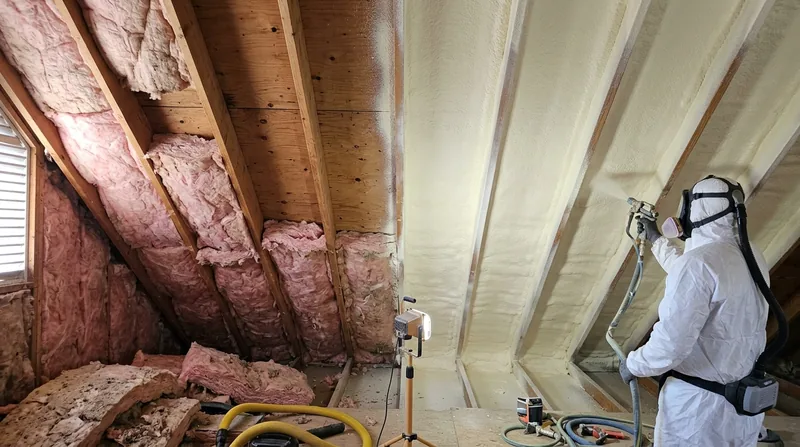




Grand Junction homes built in the mid-20th century and earlier often sit on thin, settled insulation that loses heat fast through cold winter nights and early mornings. The high desert climate here in IECC zone 5B swings from hot dry summers to freezing nights, and the stack effect pushes conditioned air straight out through attics, walls and crawl spaces that haven't been updated since the 1970s. Insulation Replacement & Re-Insulation in Grand Junction removes that failed material and installs new spray foam sized to your home's actual geometry and your local heating and cooling load. We work across Grand Junction, Clifton, Orchard Mesa, Redlands, Fruita, Palisade and the surrounding valley, tearing out old fiberglass, cellulose or blown-in material that has settled thin, and replacing it with closed cell or open cell foam that seals air leaks while it insulates. The result is a tighter home, lower utility bills, and no more cold spots on winter mornings.
Why Insulation Replacement Matters in Grand Junction's High Desert Climate
Older homes across downtown Grand Junction and along North Avenue were built with vented attics and wall cavities filled with fiberglass batts that have settled 30 to 40 percent thin over decades. Mid-century ranches in Clifton and Orchard Mesa rest on shallow crawl spaces with rim joists that leak cold air directly into living spaces. Newer subdivisions in the Redlands and Fruita have tighter construction but still lose heat at top plates, recessed lights, and band joists where the builder's insulation stops short. The real enemy in this valley is air leakage driven by the stack effect and the wide temperature swings between day and night. Cold air sinks, warm air rises, and every gap in your thermal envelope becomes a direct path for conditioned air to escape. Insulation removal paired with new spray foam closes those gaps and restores the R-value your home needs to hold heat on clear winter nights.
- Old fiberglass batts and cellulose settle thin and leave air gaps that bleed heat through the stack effect.
- Rim joists and band joists in crawl spaces are the primary path for cold air infiltration in older Grand Junction homes.
- Recessed lights and electrical outlets in attics create thermal bridges that compromise the entire insulation layer.
- Vented attics in the Redlands and Fruita subdivisions allow conditioned air to escape on winter nights when the outside temperature drops below the inside temperature.
- Spray foam seals air leaks while it insulates, stopping the stack effect and holding heat where it belongs.
Replacing failed insulation is not optional if you want to keep utility bills reasonable and avoid cold spots that invite condensation and ice dams in winter.
Key info: Grand Junction sits in a high desert valley where homes lose heat fast on clear winter nights and cool quickly in the morning. A home with thin or settled insulation can lose 30 to 50 percent of its heating energy through the attic and walls, especially if the crawl space or rim joist is open to outside air. Replacement insulation with spray foam and air sealing stops that loss and pays for itself in lower winter and summer utility bills.
How We Remove Old Insulation and Install New Spray Foam in Grand Junction
Our process starts with a walk-through of your attic, walls, crawl space or rim joist to assess what's there, how much it's settled, and where air leaks are happening. We measure the existing R-value and thickness, identify any contamination or moisture, and write a detailed estimate that names the foam type, the R-value you'll get, and the coverage thickness in inches. If the old material is in good shape and we can top it up with blown-in, we say so. If it's settled thin or wet, we remove it completely, inspect the substrate, and install new closed cell or open cell foam at the thickness your home needs. We provide mechanical ventilation during the cure period, respect the manufacturer's re-entry window of 24 to 48 hours, and leave your home cleaner than we found it.
- We inspect the existing insulation in attics, walls, crawl spaces and rim joists to measure settled material and identify air leaks.
- We write a detailed estimate with R-value, thickness in inches, and the foam type that fits your home and your budget.
- We remove old fiberglass, cellulose or failed foam if it is thin, wet or contaminated, and haul it away responsibly.
- We seal air leaks around electrical wiring, plumbing penetrations, and structural gaps before we spray new foam.
- We install closed cell or open cell foam at the thickness your estimate specifies, using proper drum temperature and manufacturer ratio.
- We provide mechanical ventilation during cure and confirm the re-entry window with you before we leave the site.
The whole job is backed by workmanship warranty and a clear understanding of what you are paying for and why.
Example: A 1970s ranch in Orchard Mesa with a shallow crawl space had 2 inches of settled fiberglass and a rim joist that was completely exposed to outside air. We removed the old material, sealed the rim joist with closed cell foam to R-21, and topped the crawl space floor with open cell to R-19. The homeowner's winter heating bills dropped 28 percent and the crawl space stayed dry through the next spring thaw.
Insulation Replacement Methods and When to Use Each
| Approach | Description | Best For |
|---|---|---|
| Closed Cell Spray Foam Replacement | High-density foam sprayed at 2 to 3 inches per pass, reaching R-6 to R-7 per inch, with a vapor barrier built in. | Crawl spaces, rim joists, attics in older homes with moisture risk, and any wall cavity retrofit where you need air sealing and moisture control in one application. |
| Open Cell Spray Foam Replacement | Lower-density foam sprayed at 5 to 7 inches per pass, reaching R-3.5 to R-4 per inch, with no vapor barrier and better sound dampening. | Attics in newer homes with dry conditions, garage ceilings, and interior walls where cost efficiency and sound control matter more than moisture protection. |
| Blown-In Insulation Top-Up | Cellulose or fiberglass blown over existing settled insulation if the substrate is clean and dry. | Attics with sound existing material that has settled 1 to 2 inches and needs a quick R-value boost without full removal. |
| Complete Removal and Replacement | Old material hauled away, substrate inspected and cleaned, new foam installed at design thickness. | Attics with settled or wet insulation, walls with old blown-in that has compacted, and any crawl space where moisture or contamination rules out a simple top-up. |
Insulation Replacement and Re-Insulation Cost in Grand Junction: What to Expect
Insulation replacement cost in Grand Junction depends on the size of the area, the depth of foam needed to reach your target R-value, whether you are removing old material or topping it up, and the accessibility of the space. A typical attic replacement in a 1,500-square-foot home with 4 to 6 inches of new open cell foam runs from $2,800 to $4,500. A crawl space with closed cell foam on the rim joist and floor typically costs $3,200 to $5,200. Wall cavity injection foam in a pre-1980 home without demolition starts at $2,500 to $3,800 per zone. If you need insulation removal first, add $800 to $1,600 depending on the volume and the haul-away distance. The single biggest variable is whether the old material is dry and stable or wet and contaminated. If we find moisture, standing water, or active leaks, we stop and walk away until the source is fixed. That is not a cost adder, it is the mark of honest work.
Get two or three written estimates from contractors who show up on site, measure the space, and name the R-value and thickness in their quote. Any estimate without R-value and thickness is a guess. Any contractor who promises immediate re-entry or skips mechanical ventilation is cutting corners. Compare the estimates side by side and ask why the prices differ. If one is far below the others with no explanation, it is a red flag. See our pricing page for a detailed breakdown of what moves costs up and down.
What to Look for When Hiring a Spray Foam Insulation Contractor Near Me in Grand Junction
The spray foam industry has two kinds of bad actors: rig-and-run crews from out of state who spray a job in an afternoon with no ventilation, no inspection, and no way to reach them when the smell does not go away, and national franchises that charge premium prices and hide behind call centers. The local independent contractor is your best bet if you know what to check. Ask any contractor for a written estimate with R-value and thickness specified in inches. No R-value on the quote means they have not done the math. Ask to see proof of general liability insurance and verify that the policy covers spray foam work. You can call the insurance company directly to confirm. Ask for references from jobs done in Grand Junction or nearby towns in the last two years, and call at least two. Ask if they pull permits and what the local building department requires at your address. Permit rules vary from Grand Junction to Clifton to Palisade, and there is no reciprocity between them. The building official at your city hall can tell you what applies. If your property is in an HOA, check the architectural rules for any restrictions on exterior work or metal buildings. Check the contractor's registration with the Colorado Secretary of State if you want a second data point, but registration is not a substitute for insurance or references. Call us at (970) 200-8449 for a free estimate and we will answer every question you have about permits, insurance, and the work itself.
- Verify that the contractor carries general liability insurance that covers spray foam work and ask to see a current certificate.
- Request a written estimate that names the foam type, the R-value, and the thickness in inches, never a price per square foot with no specs.
- Call the contractor's references and ask about the work quality, the cure timeline, and whether they were reachable after the job.
- Ask your city building department what permits and inspections apply to insulation replacement at your address.
- Check your HOA architectural rules if you live in a master-planned community, especially for any restrictions on exterior work or metal buildings.
- Avoid any contractor who promises immediate re-entry, skips mechanical ventilation during cure, or gives a price far below market with no explanation.
Contact us today for a free, no-obligation estimate and we will help you understand what your home needs and what it will cost.
Insulation Replacement & Re-Insulation in Grand Junction: Pricing Guide
| Service | Price | Details |
|---|---|---|
| Attic Replacement with Open Cell Foam | Starting at $2,800 | Removal of old material, 5 to 6 inches of open cell foam to R-18 to R-22 coverage, mechanical ventilation during cure |
| Crawl Space Rim Joist and Floor Replacement | Starting at $3,200 | Closed cell foam on rim joist to R-21, open cell on floor to R-19, includes removal of old fiberglass and substrate inspection |
| Wall Cavity Injection Foam Retrofit | Starting at $2,500 | Closed cell foam injected into existing wall cavities without demolition, per zone, typical 1,200 to 1,800 board feet per wall |
| Insulation Removal (Old Fiberglass, Cellulose, or Failed Foam) | Starting at $800 | Haul-away and responsible disposal of settled or contaminated material, typically adds 10 to 20 percent to total job cost |
| Complex or Large-Scale Job | On estimate | Multi-zone wall retrofit, entire home replacement, or jobs with moisture issues or contamination require on-site inspection and measurement |
| Free Estimate | No charge | Written quote with R-value and thickness specs, response within 24 hours, no obligation to book, call (970) 200-8449 |
Indicative pricing, the exact cost depends on square footage, finish, and site access. Free personalized estimate within 24h at (970) 200-8449.


