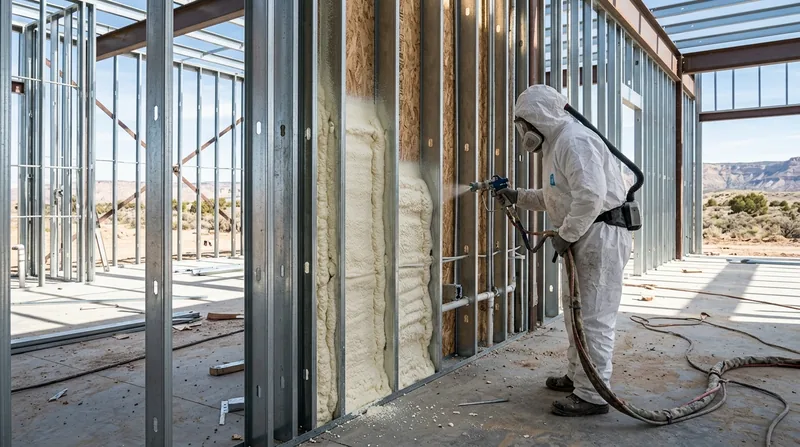




Commercial and new construction spray foam insulation in Grand Junction demands precision because the Grand Valley's climate swings hard and fast. Summer heat climbs to 95 degrees on slab foundations and metal roofs, while winter nights plunge below freezing, and the day-to-night temperature delta can exceed 40 degrees. A loose air barrier on a new commercial build or a shop addition lets that swing move through the walls and roof, driving heating and cooling loads that compound across the heating season and the dry summer peak. We work with builders across Fruita, Delta, Orchard Mesa, and Clifton to size closed cell and open cell foam to match the building envelope, the local energy code, and the actual failure modes that dominate this valley. Proper air sealing during new construction costs less than retrofit work and protects the building from day one.
Why Air Sealing Matters for New Commercial Builds in Grand Junction
New construction gives you a once-in-a-lifetime chance to seal the envelope tight before drywall, roofing, and mechanical systems go in. The Grand Valley's low humidity and wide temperature swings make air leakage the primary energy killer, not moisture. A commercial shell in Redlands or a shop in Palisade that is not sealed at the rim joist, top plate, and roof deck will lose conditioned air through stack effect on winter nights and pull hot air through every gap on summer afternoons. Spray foam creates a continuous air barrier that stops both directions of flow and eliminates the thermal bridging that happens with traditional framing and batts.
- We seal the rim joist and band joist to stop air leakage at the foundation-to-wall transition.
- We spray the underside of roof decks and truss chords to create an unbroken air barrier before sheathing and roofing go on.
- We seal around penetrations, door frames, and mechanical chases before they are closed in.
- We work to your energy code compliance and R-value specs, with written estimates that name the thickness and density.
A sealed commercial envelope in Grand Junction will run cooler in July and hold heat longer on clear winter nights, cutting peak demand and the total heating load across the season.
Key info: Colorado 811 utility locates are required by law before excavation, but spray foam work on a new commercial shell or an addition rarely involves ground disturbance. Always call 811 before any digging or foundation work, and verify with your local building department in Fruita, Delta, or Grand Junction which inspections apply to your project.
For permit and compliance questions specific to your city, contact your local building department. The City of Grand Junction Planning and Development and similar offices in Fruita and Delta govern energy code, thermal barrier requirements, and inspection timelines for new construction.
How We Size and Install Spray Foam for New Construction in Grand Junction
Every commercial build or shop addition starts with a site visit and a review of the energy code that applies at your address. Grand Junction sits in IECC climate zone 5B, which sets R-value minimums for walls, roofs, and rim joists. We assess the building envelope, the mechanical plans, and the schedule to determine whether closed cell foam (higher R-value per inch, vapor control on metal buildings) or open cell foam (lower cost, breathable for wood framing) is the right choice. Then we write a detailed estimate with thickness, board footage, and R-value so you and your contractor know exactly what is being installed.
- We schedule the spray after framing is complete and mechanical rough-in is underway, before drywall and roofing go on.
- We set up mechanical ventilation during the cure period to control odor and off-gassing.
- We spray to the specified thickness in passes, checking ratio and drum temperature to ensure proper foam rise and density.
- We observe a 24 to 48 hour re-entry window before drywall, roofing, or mechanical work resumes on the sprayed surfaces.
- We provide a written workmanship warranty covering the installation for one to three years from completion.
Once the foam is cured and inspected, your building envelope is sealed tight and ready for the next phase of construction.
Example: A light-commercial office shell in Orchard Mesa with a vented attic and rim joist air leakage typically receives 2 to 3 inches of closed cell foam on the underside of the roof deck and 1.5 inches on the rim and band joists. A metal shop in Fruita with condensation risk on steel purlins and girts gets 3 to 4 inches of closed cell to control vapor and maintain R-value. Each job gets a custom estimate based on the framing, the code, and the owner's energy goals.
For more detail on closed cell and open cell options, see our pages on closed cell spray foam insulation and open cell spray foam insulation.
Spray Foam Methods for Commercial and New Construction
| Approach | Description | Best for |
|---|---|---|
| Closed Cell Foam on Roof Deck | 2 to 4 inches sprayed to the underside of sheathing or metal decking, creating a rigid air barrier and vapor control layer. | Metal buildings, shops, and sealed attics where condensation risk or R-value per inch is critical. |
| Closed Cell Foam on Rim and Band Joists | 1.5 to 2 inches sprayed to seal the foundation-to-wall transition and stop air leakage at the rim. | All new construction on crawl spaces, partial basements, and slab-on-grade with perimeter insulation needs. |
| Open Cell Foam in Framed Walls | 3.5 to 5.5 inches sprayed into cavities to fill the stud bays and create a continuous air barrier without rigid membrane. | Wood-frame office buildings and additions where breathability and cost are balanced against R-value. |
| Closed Cell Foam in Framed Walls (Retrofit) | 1.5 to 2 inches injected into existing wall cavities from the exterior or interior without demolition. | Commercial retrofits and additions where opening the wall is not feasible or cost-prohibitive. |
Commercial and New Construction Spray Foam Cost in Grand Junction: What to Expect
The cost of spray foam for a new commercial build depends on the scope of the envelope, the foam type, and the access to the surfaces being sprayed. A free commercial estimate is your starting point. We visit the site, measure the roof deck, rim joists, and any walls or mechanical spaces that need foam, and provide a written quote with board footage, thickness, R-value, and total cost. Factors that move the price up or down include the complexity of the roof framing, the size of the rim joist detail, whether metal or wood framing is present, and the cure timeline relative to the construction schedule.
- Roof deck sealing on a 5,000 square foot shop typically costs more per square foot than rim joist work because of the volume and the equipment access required.
- Metal buildings with condensation risk usually specify closed cell foam, which costs more per board foot than open cell but delivers higher R-value and vapor control.
- Tight construction schedules that require foam to cure and be inspected before the next trade arrives may require overtime or weekend scheduling.
- Travel is included in Greater Grand Junction and surrounding areas, with no separate mileage charge or call-out fee.
For a realistic ballpark and a detailed breakdown, request a free commercial estimate. We respond within 24 hours at (970) 200-8449 with no obligation to book.
What to Look for When Hiring a Spray Foam Contractor Near Grand Junction
A spray foam contractor working on your new commercial build needs to be fully insured, provide written estimates with R-value and thickness specs, and understand the energy code and permitting timeline for your city. Verify that the contractor carries liability and workers compensation insurance and can provide a current certificate of insurance. Ask for references from recent commercial projects in Grand Junction, Fruita, or Delta, and contact them to confirm the job was completed on schedule and the foam cured without odor complaints or re-entry delays. Request a walk-through of the spray process, including how mechanical ventilation will be set up during cure and what the re-entry window is before the next trade begins.
- Check that the contractor has a local address and local plates, not a traveling rig-and-run outfit based out of state.
- Verify that the estimate includes the thickness, board footage, and R-value in writing, not just a lump sum.
- Ask whether the contractor will coordinate with your general contractor and the building department on inspections and permits.
- Confirm the workmanship warranty in writing, including the duration and what is covered.
- Get 2 to 3 estimates from different contractors so you can compare scope, price, and timeline.
A local, fully insured contractor who provides detailed estimates and references is the right partner for a new commercial build in Grand Junction. Contact us to discuss your project and get a free estimate.
Commercial & New Construction Spray Foam in Grand Junction: Pricing Guide
| Service | Price | Details |
|---|---|---|
| Free Commercial Estimate | Free | Site visit, measurement of roof deck and rim joists, written quote with R-value and thickness specifications |
| Roof Deck Sealing (Closed Cell) | Starting at $1.50 per board foot | 2 to 4 inches on roof deck or metal decking, includes foam, labor, and ventilation during cure |
| Rim and Band Joist Sealing | Starting at $1.25 per board foot | 1.5 to 2 inches on rim joist detail, foundation-to-wall transition, includes labor and inspection |
| Wall or Framed Cavity Foam | Starting at $1.10 per board foot | Open cell or closed cell in stud cavities, 3.5 to 5.5 inches, includes labor and workmanship warranty |
| Large Commercial or Complex Envelope | On Estimate | Metal buildings, multiple zones, tight schedules, or mixed foam types require site assessment before final quote |
| Travel | Included | No separate mileage or call-out fee for Grand Junction, Fruita, Delta, Orchard Mesa, Palisade, and surrounding areas |
Indicative pricing, the exact cost depends on square footage, finish, and site access. Free personalized estimate within 24h at (970) 200-8449.


