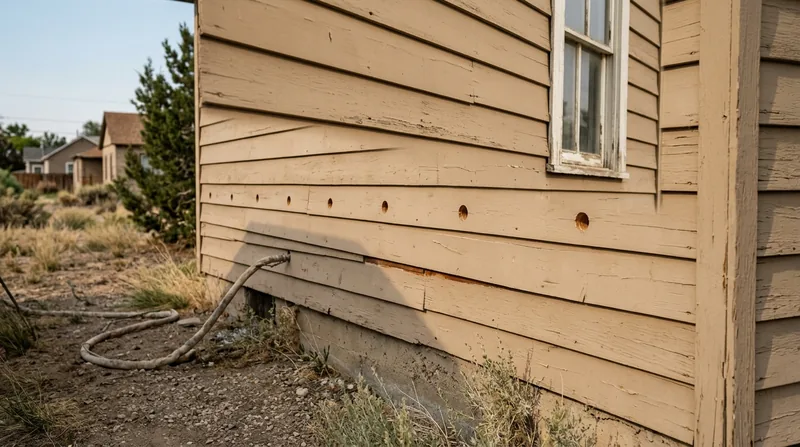




Wall & Injection Foam Insulation in Grand Junction fills the cavities of older wood-frame homes without tearing open drywall or siding, delivering thermal control and air sealing in a single pass. Grand Junction's downtown core and neighborhoods across Clifton, Fruitvale, and Orchard Mesa hold dozens of uninsulated or thin-insulated walls built before modern energy codes took hold. The high desert climate here swings hard: hot, dry summers that cook the west side of a house, and clear winter nights that drain heat fast through every gap in the envelope. Wall injection foam stops that leakage at the source, filling cavities from the outside or inside with closed-cell or open-cell spray foam, restoring comfort before the cold season arrives. Unlike fiberglass batts settled thin over decades, injection foam fills every void and seals the air boundary in one step. We help homeowners across the Grand Valley understand whether their walls need insulation, what type fits their budget and climate, and how to get it done right.
Why Wall & Injection Foam Insulation Matters in the Grand Junction High Desert
The stack effect dominates heating and cooling losses in Grand Junction homes. Cold air sinks and escapes through the basement rim joist and foundation, while warm air rises and leaks out through the attic. But the walls are the silent middle player: uninsulated or poorly insulated cavities in pre-1980 construction let the outside temperature migrate straight into living spaces. On a January night when the valley floor drops to 15 degrees, an uninsulated wall radiates heat to the outside at a rate that no furnace can match. In July, the same wall conducts 95-degree heat inward, forcing air conditioning to run harder. Wall injection foam stops both directions of heat flow without opening the wall or disturbing finishes.
- Fills closed cavities in wood-frame walls without drywall removal or exterior siding demolition.
- Seals air leakage paths that fiberglass batts cannot reach after settling over thirty or forty years.
- Works on downtown Grand Junction homes, mid-century ranches in Clifton and Orchard Mesa, and retrofit projects across Redlands and Fruita.
- Improves comfort in winter by reducing radiant heat loss and in summer by blocking conductive gain.
- Pairs with rim joist and band joist sealing to close the whole thermal envelope.
Wall injection is the retrofit answer for homes where opening walls is not an option, and it delivers measurable comfort gains in the valley's extreme day-to-night temperature swings.
Local example: A 1960s ranch on the north side of Grand Junction with uninsulated wood-frame walls and a vented attic loses heat fast on clear winter nights. Wall injection into the exterior walls, combined with attic foam, cuts the heating load by 25 to 35 percent and eliminates cold drafts along the rim joist and baseboards.
For more on how to verify a contractor's credentials and insurance, check the Colorado Department of Local Affairs, which oversees contractor registration requirements that vary by city and county across the state.
How Wall & Injection Foam Insulation Works: The Grand Junction Approach
Wall injection foam is a retrofit method that requires no major demolition. We drill small holes (typically 1 to 1.5 inches) into the wall cavity from outside or inside, depending on access and finishes. Closed-cell foam is injected at low pressure to fill the cavity completely, expanding slightly to seal all voids and air gaps. The process takes hours, not days, and the wall is ready for patching and paint within 24 to 48 hours. In Grand Junction's dry climate, moisture is not the limiting factor that it is in coastal or humid regions; air leakage and thermal bridging are the real enemies, and injection foam addresses both.
- We locate the wall cavities and identify any electrical wiring, plumbing, or gas lines before drilling.
- Holes are drilled at intervals along the wall, typically one hole per stud cavity or per 16 inches of wall height.
- Closed-cell or open-cell foam is injected at controlled pressure and temperature to fill the cavity without overpacking.
- Holes are patched with foam-compatible caulk or sealant and finished to match existing walls.
- We verify coverage with a thermal camera or by measuring foam density and expansion to confirm full cavity fill.
The result is a continuous air barrier and thermal break that stops heat flow and air leakage across the entire wall assembly.
Real scenario: A 1970s home in downtown Grand Junction with two-story wood-frame walls and no cavity insulation. We inject closed-cell foam into the cavities from the outside, working from a lift or ladder on the side of the house that faces the prevailing winter wind. The job takes one to two days, and the homeowner avoids the expense and disruption of ripping out drywall and rebuilding.
Learn more about how closed-cell spray foam performs in high-desert climates and why it's the standard choice for wall cavities.
Wall & Injection Foam Methods: Choosing the Right Approach for Your Home
| Method | Description | Best For |
|---|---|---|
| Closed-Cell Injection | High-density foam injected into cavities at low pressure, expanding to fill voids and seal air leaks. R-value 6 to 7 per inch. | Exterior walls in cold climates, walls with air leakage, retrofit projects where cavity depth is limited. |
| Open-Cell Injection | Lower-density foam injected to fill cavities and dampen sound. R-value 3.5 to 4 per inch. Softer, more flexible. | Interior walls where sound control is desired, retrofit projects with budget constraints, homes not in flood zones. |
| Exterior Injection (No Interior Disturbance) | Holes drilled from the exterior side of the wall, foam injected from outside. Finishes on the inside are never touched. | Occupied homes, historic interiors, homes with finished basements or valuable interior walls. |
| Interior Injection (Limited Access) | Holes drilled from inside when exterior access is blocked by roof decks, landscaping, or siding too expensive to remove. | Homes with mature landscaping, tight lot lines, attached garages, or when exterior finishes must be preserved. |
Wall & Injection Foam Insulation Cost in Grand Junction: What to Expect
Wall injection foam is priced per square foot of wall cavity being filled, and costs typically start at $2 per square foot for straightforward exterior walls in good access conditions. A 2,000-square-foot home with 1,000 square feet of uninsulated wall cavity runs $2,000 to $3,500 depending on cavity depth, foam type, hole location (interior versus exterior), and the complexity of patching and finish work. Factors that move the price up include deep cavities requiring multiple injection points, electrical wiring or plumbing inside the walls, older homes with irregular stud spacing, and exterior finishes that are expensive to patch. Interior injection is often cheaper than exterior because it avoids the need for lifts or complex patching of siding. On-site estimates are free and give you a firm number for your specific walls.
The best way to understand cost is to get two or three estimates from contractors who measure your walls on site and specify the foam type, R-value, and cavity coverage in writing. Our pricing page shows realistic ranges for different wall types and access conditions. Call us at (970) 200-8449 for a free estimate tailored to your home.
Wall & Injection Foam Insulation Near Me: What to Look for When Hiring a Contractor in Grand Junction
Finding a qualified spray foam contractor in Grand Junction means checking insurance, understanding the estimate, and verifying that the contractor has experience with wall injection in older homes. Spray foam work carries liability and property damage risk, so the contractor must carry fully insured coverage that you can verify with a call to their insurance agent. An honest estimate includes the foam type (closed-cell or open-cell), R-value per inch, the number and location of injection holes, and the patching and finish plan. Avoid contractors who offer a price per board foot without an on-site inspection, who promise immediate re-entry without a 24 to 48-hour cure window, or who cannot describe their injection pressure and temperature controls.
- Verify that the contractor carries fully insured coverage and can provide a certificate of insurance before work begins.
- Ask for an estimate that names the foam type, R-value, thickness, and the total square footage of cavity being filled.
- Check references from homeowners in Grand Junction or nearby towns who have had wall injection work done in the past two years.
- Understand permit requirements by calling your city building department, which varies between Grand Junction, Clifton, Redlands, and other areas in the valley.
- Ask about the contractor's cure timeline, mechanical ventilation during application, and when the wall is safe to paint or finish.
Getting multiple estimates protects you from low-ball pricing and gives you confidence in the scope and quality of the work. Contact us for a free, no-obligation estimate and to discuss your specific walls and budget.
Wall & Injection Foam Insulation in Grand Junction: Pricing Guide
| Service | Price | Details |
|---|---|---|
| Closed-Cell Wall Injection | Starting at $2/sq ft | Exterior or interior cavity fill, R-value 6 to 7 per inch, includes one patch per cavity |
| Open-Cell Wall Injection | Starting at $1.50/sq ft | Budget-friendly retrofit option, R-value 3.5 to 4 per inch, good for interior walls and sound dampening |
| Exterior Injection (No Interior Access) | Starting at $2.25/sq ft | Drilled from outside, protects interior finishes, requires lift or ladder access to wall perimeter |
| Complex or Multi-Story Home | On estimate | Irregular stud spacing, plumbing or electrical in walls, or extensive patching may require on-site assessment |
| Travel & Estimate | Free | Included in Greater Grand Junction area, response within 24 hours at (970) 200-8449 |
Indicative pricing, the exact cost depends on square footage, finish, and site access. Free personalized estimate within 24h at (970) 200-8449.


