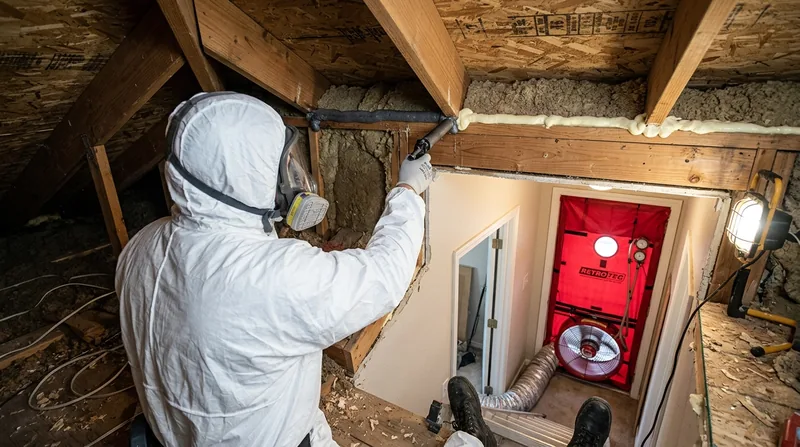




Air sealing in Grand Junction stops the stack effect that drives heating and cooling loss through winter and summer. Grand Junction's high desert climate, with hot dry days and cold nights that swing 40 degrees in a single rotation, pushes air through every unsealed gap in your home. Older crawl space houses near downtown, mid-century ranches across Clifton and Orchard Mesa, and newer slab-built homes in the Redlands all leak at the top plate, rim joist, and around penetrations. We seal those leaks with spray foam and caulk, often paired with a blower door test to measure the improvement. Air sealing is the foundation of energy control in this valley, and it works year-round.
Why Air Sealing Matters in Grand Junction's High Desert Climate
The stack effect is the invisible force that moves air through your home. In winter, warm air rises and escapes through the attic while cold air gets drawn in at the basement and crawl space. In summer, the stack effect reverses but the leak paths stay the same. Grand Junction homes lose conditioning through the same holes all year, and the wide day-to-night temperature swings make those leaks costly. A single unsealed top plate or rim joist can cost you hundreds of dollars a season in wasted heating and cooling.
- Sealing the top plate stops warm air from rising into the attic in winter and prevents conditioned air from escaping through the ceiling.
- Sealing rim and band joists closes the gap between the foundation and the rim board where the stack effect pulls air directly into the basement or crawl space.
- Sealing penetrations around electrical outlets, plumbing stacks, and HVAC chases stops air leakage at every point where the envelope is broken.
- Pairing air sealing with a blower door test measures the tightness before and after so you know what you gained.
Air sealing is not optional in a valley where humidity stays low and the real enemy is air movement, not moisture. The Colorado energy code requires air sealing at the building envelope, and the local building department will enforce it on new construction and major retrofit work. For more detail on what the code requires at your address, contact your city building department or review the Colorado Division of Plumbing and Gas.
Key info: A home in downtown Grand Junction with a vented attic and unsealed top plate can lose 20 to 30 percent of its heating and cooling to air leakage alone. Sealing that top plate with closed cell foam typically costs $800 to $1,200 and pays for itself in 3 to 5 years through lower utility bills.
How We Seal Your Home: Step by Step in Grand Junction
Air sealing starts with finding where the air is going. We use a blower door test to pressurize your home and identify leaks, or we perform a visual inspection of the attic, crawl space, and rim joist to spot the obvious culprits. Once we know the leak paths, we seal them with closed cell spray foam, open cell foam, or caulk depending on the gap size and location. Spray foam fills cavities and irregular shapes; caulk works for narrow seams. Every job ends with a post-seal blower door test so you see the before and after.
- Perform a blower door test or visual inspection to find air leaks in the attic, crawl space, rim joist, and around penetrations.
- Seal top plates and rim joists with closed cell spray foam, which hardens into a rigid air barrier and adds R-value.
- Seal penetrations around electrical outlets, plumbing stacks, ductwork, and HVAC chases with foam or caulk.
- Seal band joists and rim board gaps where the foundation meets the sill plate.
- Run a post-seal blower door test to measure the improvement in air tightness and confirm the work.
The entire process takes one to three days depending on the size of your home and the number of leak paths. We work inside the attic and crawl space, so access and headroom matter. Homes in Orchard Mesa and Redlands with trussed attics and tight framing are faster than older downtown homes with hand-framed rafters and scattered penetrations.
Example: A ranch home in Fruita with a crawl space and a vented attic had an air leakage rate of 8,500 CFM50 (cubic feet per minute at 50 pascals). We sealed the top plate, rim joist, and band joist with closed cell foam and caulked the penetrations. The post-seal test showed 4,200 CFM50, a 50 percent reduction in air leakage and a measurable drop in the homeowner's winter heating bill.
For homes with settled insulation or gaps in the attic, air sealing is often paired with attic spray foam insulation to restore both the air barrier and the R-value.
Air Sealing Methods and When to Use Each
| Approach | Description | Best for |
|---|---|---|
| Closed Cell Spray Foam | Rigid foam that hardens in place, creates an air and moisture barrier, R-value 6.0 to 7.0 per inch. | Top plates, rim joists, band joists, and crawl space rim board where air sealing and insulation value matter equally. |
| Open Cell Spray Foam | Softer foam that cures in place, excellent air seal, lower R-value of 3.5 to 3.6 per inch, vapor permeable. | Attic rafter bays and wall cavities where air sealing is the primary goal and R-value is secondary. |
| Caulk and Sealant | Flexible sealant for narrow seams and gaps under 1 inch, low cost, easy to inspect and repair. | Penetrations around electrical outlets, plumbing stacks, light fixtures, and seams in rim board framing. |
| Blower Door Testing | Pressurizes the home to measure air leakage in CFM50, identifies leak paths, documents before and after sealing. | Any air sealing job to confirm the work and quantify the improvement in home tightness. |
The choice of method depends on the gap size, the location, and whether you need insulation value alongside the air seal. Top plates and rim joists in Grand Junction homes almost always get closed cell foam because those areas have no existing insulation and the thermal benefit is immediate. Penetrations and narrow seams get caulk to keep costs down. Attics with settled fiberglass may get open cell foam if the goal is air sealing without disturbing the existing insulation below.
Air Sealing Cost in Grand Junction: What to Expect
Air sealing cost in Grand Junction ranges from $650 to $2,500 depending on the scope and the size of your home. A single rim joist or top plate in a small home might start at $650. A full air sealing job that includes the attic, crawl space, and rim joist in a larger home typically runs $1,200 to $2,000. The main factors that move the price are the number of leak paths, access to the attic and crawl space, and whether you include a blower door test before and after.
- Top plate sealing in a ranch home starts at $750 to $1,200 depending on the square footage and the complexity of the framing.
- Rim joist and band joist sealing in a crawl space home runs $600 to $1,000 depending on the perimeter and the number of band joist sections.
- Penetration sealing around electrical outlets, plumbing stacks, and HVAC chases adds $200 to $500 depending on the number of penetrations.
- Blower door testing adds $300 to $500 for a full before and after assessment of air tightness.
- Full-home air sealing including attic, crawl space, rim joist, and penetrations typically runs $1,500 to $2,500 on estimate.
Every home is different, and the only way to know the exact cost is to get an on-site estimate. We provide written estimates with R-value and thickness specs so you know what you are paying for. Travel is included in Grand Junction and surrounding areas, and the estimate is free with no obligation to book. Call us at (970) 200-8449 or visit our pricing page for more detail on what drives the cost up or down.
Getting two or three estimates from different contractors is smart practice. Compare what each one includes: the blower door test, the R-value specs, the warranty on the installation, and the timeline. The cheapest estimate is not always the best. A contractor who skips the blower door test or promises immediate re-entry without mechanical ventilation is cutting corners that will show up in your utility bills.
What to Look for When Hiring an Air Sealing Contractor Near Me in Grand Junction
Hiring the right contractor for air sealing in Grand Junction means checking credentials, getting multiple estimates, and understanding what the work includes. A good contractor is fully insured, provides a written estimate with R-value and thickness specs, and explains the blower door test before and after. They should also be clear about permits, re-entry windows, and mechanical ventilation during cure. Avoid contractors who promise immediate re-entry, who cannot show proof of insurance, or who quote a price per square foot without an on-site inspection.
- Verify that your contractor is fully insured and can provide a certificate of insurance before work starts.
- Ask for a written estimate that includes the R-value, the thickness of foam, the locations being sealed, and the total cost with no surprises.
- Request references from recent jobs in Grand Junction, Fruita, Palisade, or Redlands and call them to ask about the experience and the quality of the work.
- Confirm that your contractor will provide a blower door test before and after sealing so you can see the improvement in air tightness.
- Ask whether permits are required at your address and confirm that your contractor understands the local building code and the local building department's requirements.
- Understand the re-entry window (typically 24 to 48 hours) and ask whether the contractor will provide mechanical ventilation during cure to keep odors and VOCs at a safe level.
Air sealing is a technical skill, and the difference between a tight, durable seal and a leaky, off-gassing one comes down to technique: controlled thickness per pass, the correct drum temperature, the right mixing ratio, and proper ventilation during cure. A contractor who rushes through the job or skips these steps will leave you with a poor seal and a home that still leaks. Contact us at Grand Junction Spray Foam Insulation for a free estimate and a chance to ask questions before you commit.
Air Sealing in Grand Junction: Pricing Guide
| Service | Price | Details |
|---|---|---|
| Rim Joist or Band Joist Sealing | Starting at $650 | Single rim board section with closed cell foam, includes material and labor, price increases with perimeter length |
| Top Plate Sealing | Starting at $850 | Attic top plate with closed cell foam across full perimeter, cost varies with square footage and framing complexity |
| Penetration Sealing | Starting at $200 | Electrical outlets, plumbing stacks, and HVAC chases, priced per penetration or as a package for multiple areas |
| Full-Home Air Sealing with Blower Door Test | On estimate | Attic, crawl space, rim joist, and penetrations sealed with before and after blower door testing included |
| Travel | Included | No mileage fee or travel charge for Grand Junction and surrounding service areas within valley |
| Estimate | Free | Written estimate with R-value and thickness specs, response within 24 hours at (970) 200-8449 |
Indicative pricing, the exact cost depends on square footage, finish, and site access. Free personalized estimate within 24h at (970) 200-8449.


